Sunday, 17 January 2016

Celebrity MBTI Types: The 2016 Republican and Democrat Primaries


This article has been inspired by Rod Novichkov's controversial book on Socionics, How to Find Yourself and Your Best Match (2007). The book outlines a method of visual identification (VI) for determining the 16 Socionics personality types and types a large number of celebrities according to the method.

Among the celebrities we find former US presidents Ronald Reagan (ENTj) , Bill Clinton (ESTj), George W. Bush (ESTp) and would-be president Donald Trump (ISTp in Socionics, ISTJ in MBTI). I've been watching the televised debates for the primaries (like millions of other people) and I thought it'd be fun to type each of the candidates using Novichkov's methods. I won't get political here, but I will point out, in one or two pertinent instances, how a candidate's personality type seems to relate to his politics.

Novichkov's book has aroused controversy and scepticism in the 'Socionics community' (however that may be defined) and some readers here may be inclined to compare it to pseudo-sciences such as phrenology. In my experience, however, the method gives accurate results.

Novichkov's method consists of visual identification from a person's face, eyes, neck, hands, posture, expressions and movements. This helps us distinguish between the dichotomies found in Socionics / MBTI:

JUDGERS vs. PERCEIVERS, RATIONALS vs. IRRATIONALS, CONCEIVERS vs. PERCEIVERS: A person's dominant function belongs to either the 'perceiving / irrational' (sensing or intuiting) pair or the 'judging / conceiving / rational' pair (thinking or feeling). Suppose that your dominant function is Fi, introverted feeling: this makes you, in Socionics, a 'judger'. Hence the letter 'j' in ISFj or INFj. (To confuse things, an ISFj in Socionics would be a ISFP in MBTI. That's because the capital letter P or J in MBTI signifies which function - perceiving or judging - is extraverted. The ISFP's perceiving function points outwards - i.e., is extraverted - and so MBTI puts the capital letter P at the end of ISF..).

In Novichkov, the neck of the judger seems to go like a bolt right through the center of the bottom of the skull, and usually the judger has a long neck with a flat back. Let's take a look at Carly Fiorina:


In contrast, the perceiver or 'conceiving' type's neck angles towards the back of the bottom of the skull, and the skull (in Novichkov's diagram) resembles a ball hanging off the side of a post. The neck of a perceiver tends to be short. Let's look at Marco Rubio:


THINKERS vs. FEELERS: A person's primary or secondary function falls into the 'judging' or 'rational' category - thinking or feeling, T or F in both Socionics and MBTI.

The face of a thinker possesses the following traits: an expressive forehead which is larger than the rest of the face, strongly pronounced superciliary arches (the bone under one's eyebrows) sticking out, angular or flat bridge of nose, deep eye sockets, sharp and aquiline nose, inexpressive lower face. That's a good description of Rand Paul:


The face of a feeler differs and has these traits: rounded and small forehead, smooth superciliary arches, rounded bridge of nose, shallow eye sockets, rounded and pug-shaped nose, wide and expressive lower face (in contrast to the forehead). That sums up Chris Christie:


SENSOR vs. INTUITIVE: A person's secondary or primary function must be a perceiving, 'irrational' one: either sensing (perceiving the outer, material world) or intuiting (perceiving the inner, mental world). Using Novichkov's method, we can categorise people as either extraverted or introverted sensing or intuiting, respectively, by studying their gaze. But, to work out whether or not a person is a sensor or intuitive (extraverted or introverted), we need to look at their body, especially their hands.

We find, in the typical sensor, ample and full lips, fleshy faces, full figures, and, most importantly, thick, stocky hands.

In my experience, the hands of a sensor tend to be buffed (that is, smooth), symmetrical and either very big or square-shaped. Let's look at Donald Trump, who was famously derided by Spy magazine in 1988 as a 'short-fingered vulgarian':


In addition, sensors will sit or stand in a comfortable, 'normal' position: that is, they won't loll around the place, or bend limbs and shoulders in opposite, asymmetric directions.

I've found, when watching the televised debates, that the sensor candidates tend to use squarish hand and arm movements when illustrating a point. They like to trace squares in the air (as opposed to circles) and make cutting motions.

The intuitive type presents a world of contrast to the sensor. The typical intuitive possesses skinny lips, skinny faces, skinny builds and skinny, unshapely, knuckled hands. The hands of an intuitive tend to be long with knuckled fingers like tendrils, or small and gnarly.

Unlike the sensors, the intuitives will sit or stand in uncomfortable, apparently awkward, disjointed and unstable positions. The INTP type (in MBTI, INTj in Socionics) provides us with the most typical and widely known example of an awkward, gangly, all over the place intuitive.


In the debates, the intuitives reveal themselves by bending and shifting around a lot, and tracing circles and making sweeps with their hands. Bernie Sanders (an intuitive) bends and tilts his body a lot, while on the same stage the movements of an O'Malley (a sensor) seem rigid, square and jerky in contrast.

I've found it difficult to distinguish the intuitive from the sensor candidates, simply because many of them have put on weight with age, and so they don't give us good examples of the standard skinny and gangly intuitive type. Fortunately, the Internet serves as a time machine, and can take us back in time to when the candidates were younger. Let's look at Hilary Clinton (an intuitive) from her college days: these highlight the intuitive's hands and the intuitive's rather unusual positioning when seated:


EXTRAVERTS vs. INTROVERTS: The letter E or I at the start of the type description indicates whether one is an extravert or an introvert.

In Novichkov, introverts often appear withdrawn, absent, apathetic (even melancholic) and entirely absorbed on what's going on inside their heads: their energy is turned inwards, not outwards. We see that in the debates. Trump, an introvert, often seems preoccupied and not listening to the other candidates, and his face seems impassive. It's only when his name is mentioned, and when he's being attacked, that his emotions come to the fore and he begins mugging, grimacing, pulling odd facial expressions, etc. A recent analysis shows that, out of all the candidates, Trump and Cruz (another introvert) show the lowest levels of stress. (Carson, another introvert, appears calm, disengaged and relaxed to the point of somnambulism).


Extraverts show the opposite: their facial expressions mirror what's going on around them and they seem entirely absorbed in their environment. They will show a great deal of tension and nearly always look, in the words of Novichkov, 'involved, engaged, and passionate'. Bernie Sanders always appears tense and involved, and is always paying attention to his surroundings.


Let's go through the candidates. Following Socionics, I'll divide them up into quadras.

ALPHA QUADRA

Senator Marco Rubio (Republican) - ISFp (ISFJ in MBTI)

The impassivity and calm typical of Rubio, along with his facial features (pug nose, expressive lower face, etc.), perceiver's neck and stocky square hands make Rubio an ISFp. Introverted sensing occupies the place of dominant function in an ISFp, and Novichkov tells us that introverted sensors possess unfocused, 'swimmy' eyes that tend to look over your shoulder and not at you. I would put it this way: there seems to be a force field around them which only they can see, and it's this - and not you - which receives their attention. They are looking at the force field, not you.


Senator Rick Santorum (Republican) - ESFj (ESFJ in MBTI)

Another introverted sensor, like Rubio, the ESFj type resembles the ISFp in many ways. In Socionics, the relationship between the ESFj and ISFp is called a 'mirror'. The main differences lie in Santorum's 'judger' neck and the warmth and animation of his facial expressions. He grins and smiles a lot, comfortably and naturally, while, in an introvert like Rubio or Trump, a smile always seems forced. The ESFj likes to be liked.


Senator Bernie Sanders (Democrat) - ENTp (ENTP in MBTI)

A typical intuitive, the gangly Sanders has awkward, disjointed scarecrow-type posture, movements, gestures and long, tendril-like, misshapen fingers. His aquiline face marks him to be a thinker, and his gaze is one an extraverted intuitive's - which, according to Novichkov, bores right through you. While he moves around in a fluid, relaxed fashion, his face always seems tense; he seems to be the most serious-looking out of all the candidates.


Former Governor Mike Huckabee (Republican) - ESFj (ESFJ in MBTI)

It's somewhat hard to make out if Huckabee has the judger's neck underneath all that fat - Huckabee is seriously overweight - but, believe me, it's there. Again, we note the floating, disengaged gaze which contrasts with the engaged, animated facial expression - a contrast we find in Santorum. Fe dominant, like Hilary Clinton, Huckabee, as a preacher and a politician (who delivers his speeches in lulling, soothing tones) likes to orchestrate the emotions of the audience - he seeks to build a rapport and maintain an atmosphere. Note, too, that Huckabee's movements and gestures seem short and choppy, and generally holds himself in a square and rigid way - the marks of a sensor and a judger.


BETA QUADRA

Governor John Kasich (Republican) - ENFj (ENFJ in MBTI)

Like Sanders, Kasich has a poor posture, and like a few of the older candidates, has developed jowls with age, so, as with Huckabee, you'll be hard-pressed to see his judger's neck - but, as with Huckabee, it's there if you look.


Like Sanders, he strikes us as a typical intuitive. He's attracted a lot of criticism for his shuffling, flouncing and wild, dramatic gesturing during the debates (the actions of an intuitive) combined with his emotionalism and occasional petulance (the marks of a feeler). Sanders can get away with waving his long, intuitive's hands about with wild abandon, but Kasich can't.

In ENFjs, we find introverted intuition (Ni) as a secondary function. According to Novichkov, this gives them a rather spacey, 'absent' gaze:

These people are as far from reality as possible. They tend to live in their own world, and stick to their own understanding of things. Their wide open eyes, devoid of any squint, look into eternity, and don't pause on material objects. 

This Ni gaze I call 'cosmic' - after the 'cosmic' books of comic artists Jim Starlin and Jack Kirby. See this cover of the comic book series Godland for what I mean by a 'cosmic' gaze.


Kasich, being an introverted intuitive, has this.

I'll point out that Kasich bears a striking resemblance to another celebrity, the late British author Colin Wilson (another ENFj), see below.


Former Governor Martin O'Malley (Democrat) - ESTp (ESTP in MBTI)

To a certain extent, O'Malley resembles another famous ESTp politician, George W. Bush, and like Bush, has that crane-like perceiver's neck, and the deep set eyes, wide and expressive forehead, etc., of a thinking type. Like the characters played by Vince Vaughn (who Novichkov identifies as another ESTp), O'Malley seems fun loving and likes to be liked.


Novichkov states that extraverted sensors have a clear, open, 'running' gaze which scans you. I would define it as a twitchy, nervous, vigilant and watchful gaze... O'Malley, an Se (extraverted sensing) dominant, shows this: he always seems to be looking at something in his environment.

But, in the extraverted sensor's gaze, we always find flashes of the opposite - Ni (introverted sensing). And, vice versa, the same goes for Ni types: they will always display a little extraverted sensing here and there.


Former Secretary of State, Hilary Clinton (Democrat) - ENFj (ENFJ in MBTI)

Like many of the other candidates, Clinton has aged and put on weight, and so her frame has become distorted somewhat. We find it hard to determine if she's a) a sensor or intuitive and b) a judger and a perceiver. We can go by the photographs of her younger self to find out the answers to these questions: we see from below, for example, that she has the judger's neck:


But, if we know our Socionics (or MBTI), we can make a few quick deductions without the aid of these photographs. Her spacey, extremely absent gaze makes her an introverted intuitive; her facial type (feeler, not a thinker, unlike her husband Bill) and signs of an extreme extraversion make her out to be an extravert and a feeler. On top of that, we see, in the debates, a lot of circular, waving gestures. Plus, we see that she had, in her youth, long, spindly and knuckled fingers (which, in her old age, have become somewhat gnarled and knuckly). That gives us ENFj.


 Clinton really enjoys revving up an audience and getting applause, and ENFj leaders have always shown themselves to be talented at welding disparate individuals in the audience into one group and directing their emotions.

GAMMA QUADRA

Governor Chris Christie (Republican) ESFp (ESFP in MBTI)

As a youngster, Chris Christie looks like another celebrity who is an ESFp (in my opinion), Bill Joel. We find the clear, unblinking gaze of the extraverted sensor:


I don't have much else to say about Christie, except that he comes across - to many people - as being pushy, forceful, even something of a bully. That's to be expected from an Se dominant, because Se means, above all else, force, volition, will, and the imposition of that will on one's environment - and others.

Senator Ted Cruz (Republican) - INTp (INTJ in MBTI)

An introvert, a thinker, a perceiver, an intuitive whose hands, gestures and movements remind us of Sanders' and Kasich's. Does he have the absent, 'spacey' introverted intuitive gaze? Yes, most of the time, but as with all introverted intuitives, we see a Se occasionally flashing through his eyes.

It's interesting that the INTJ type in MBTI is perhaps the most maligned, and that, popular culture, the villain - usually the brilliant, evil criminal mastermind who plots and schemes whilst sitting in darkness - is an INTJ: think of Doctor Doom, Smaug, Palpatine and countless others. INTJs appear as the good guy (Batman) and the anti-hero (Walter White in Breaking Bad) but more often than not as the bad guy.

INTJs get a bad rep, that's for sure, and that could explain, in part, why Cruz seems to be distrusted by so many in the electorate - even those who vote Republican.


Retired neurosurgeon Doctor Ben Carson (Republican) - ISFj (ISFP in MBTI)

Introversion, a feeler's face, a judger's neck, probing eyes and emphatic, jerky (somehow 'squarish') hand movements and body language make Carson an ISFj. He could almost be an intuitive - after all, he has long fingers - but his hands seem too smooth for that, and besides which, he seems too tough to be an INFj (INFP in MBTI). Taking into consideration his stories of an attempted stabbing of a relative and other physical confrontations (regardless of whether those stories are true or not), it's clear that Carson wants to project a tough guy image. And ISFjs have garnered the reputation of being tough - it's the Se in them.


Former technology executive and CEO Carly Fiorina (Republican) - ENTj (ENTJ in MBTI)

You'd expect a former CEO to be an ENTj, wouldn't you? It's a cliché in MBTI and Socionics that an ENTj will be a CEO or general or head of state or something along those lines, and certainly, in popular culture at least, plenty of ENTjs can be found in those roles.

Like Hilary, Fiorina is an intuitive, but unlike Hilary, she resembles the more typical intuitive: skinny, gangly, thin-lipped, long-fingered, etc. Being an introverted intuitive (like Kasich, Hilary, and Cruz), she looks at you with the same spacey, absent gaze. She resembles Cruz, but her face shows a lot more involvement in the outer world and lot more tension - she's an extravert. And, as a judger and not a perceiver, she's more commanding.


DELTA QUADRA

Former Governor Jeb Bush (Republican) - ENFp (ENFP in MBTI)

An extravert, feeler and an intuitive (with an extraverted intuitive gaze that bores right through) - he can only be an ENFp. Like other intuitives in the race, we find gangliness, awkwardness, wavy and circular hand motions...

I call the ENFp type 'everybody's friend', and they certainly do like everyone and want to be liked in return. They force intimacy on people - that is, like the drunken Barney Gumble from The Simpsons, they'll stand up close (too close) to you, breathe and burp in your face and tell you all about themselves and their lives.

They can seem corny and gauche, which is another way of saying that they're uncool.


The squishy, emollient Bush fits the bill. Regarding the forced intimacy, for example, he put up on his website an embarrassing (for his readers, not for him) account of his courtship with his wife Colomba. As for the zaniness, well, he strikes plenty of people as zany and he does zany things - such as retailing Jeb Bush guacamole dip bowls for $USD70.

Jeb has become the butt of many a joke. He's hardly anyone's idea of a man's man. Which brings us to Mr Macho himself...

Businessman Donald Trump (Republican) - ISTp (ISTJ in MBTI)

One of the first things you notice about Trump is his introverted sensing gaze: he seems to be the complete opposite of extraverted intuition (Ne) or sensing (Se). This goes with the general impassivity and introversion of his face. The Donald does display anger and scorn on occasion, but generally he appears placid, even melancholy. EJ Arendee on YouTube once typed him as an ISTp, then changed his mind and declared him to be an ESTj; he was right the first time. Trump can't be an extravert like an ESTj. (Besides which, he has a perceiver's neck).

Being a thinker, most of his expressiveness can be found, not in the lower part of his face, but in that furrowed brow.

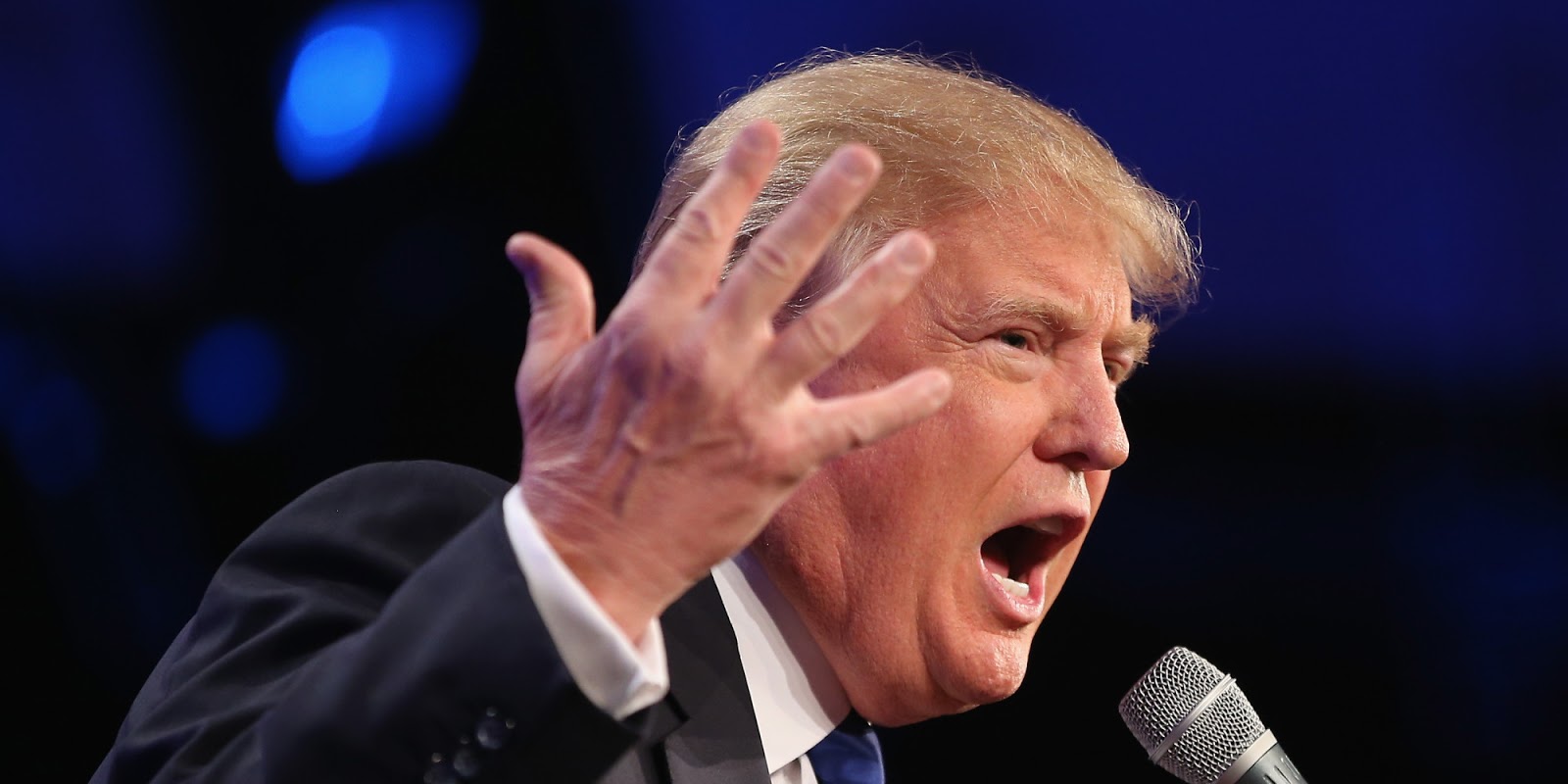


As Si dominants, ISTps are concerned with creating a comfortable and secure environment for themselves; they seem to live in a bubble, or, as EJ Arendee memorably put it, a snow globe. Trump's 'Make America Great Again' and 'We don't win anymore' slogans, and indeed, his entire campaign, evoke the ISTp type, who is forever asking, 'Why can't things be like they used to be?'.

Senator Rand Paul (Republican) - ESTj (ESTJ in MBTI)

The tense, wiry and flappable version of the Donald, Rand is an extravert and a judger - which makes him an ESTj. He has the same 'swimming' introverted sensing gaze.


You'd expect an ESTj to do well in a presidential contest: according to Novichkov, Bill Clinton is an ESTj and (in my estimation) so was John F. Kennedy. Extraversion and a dominant judging function lend themselves to leadership, but at this point, Rand is polling well below two perceivers and introverts - Trump and Rubio.

Mark Hootsen signing off.


Friday, 27 November 2015

The Joys of McDougallism


I've been a vegan for ten years, and have always considered myself to be in good health. This year, however, I noticed in some photographs that I had a protruding stomach - not a beer belly, but the beginnings of one. I bought some scales and to my shock and horror, discovered that I weighed 82 kilos. I'd always assumed that I weighed 75-77 kilos.

I became determined to lose weight. I'd been aware for some time that Australia did have a growing weight problem and that Australians and Americans seemed to be more obese, or at least more pudgy, than they were decades ago - in the 1970s and 1980s. Watch any film or TV show from that period and you'll see how skinny the actors are. Being skinny came naturally to male actors in particular back then - look at how skinny Harrison Ford was in the first three Star Wars movies, for instance - but now male actors and celebrities, it seems, have to fight to stay in shape. I looked at some of the extreme diets taken by celebrities Matthew McConaughey, Jake Gyllenhaal, Patrick Bateman and Al Sharpton. If you want to follow any of these, you need get used to eating very little. Gyllenhaal subsisted on a diet of kale and chewing gum while filming Nightcrawler (2014). I tried a variant on this - I ate only two slices of toast for dinner every night, for example - and lost a few kilos. But as could be expected, this sort of self-denial proved to be unsatisfactory and unsustainable. So Hollywood methods didn't really work for me.

The work of Dr John McDougall turned out to be my salvation. I had read one of McDougall's books - The McDougall Program: Twelve Days to Dynamic Health (1990) - the year before and had attempted to put its recommendations into practice in a desultory way. I gave up coffee, and bought all the food in his 12-day diet program with the intention of eating it.

But I didn't have the time to prepare three different meals a day for 12 days - really, I needed a chef to do it for me - and I couldn't stay from coffee for long. I did introduce one permanent change to my diet, however: I stopped using vegetable oil and oily foods such as peanut butter and potato chips.

To find the easiest to read summary of McDougall's ideas, download this PDF of 'Doctor McDougall's Color Picture Book': "Food Poisoning" - How to Cure It by Eating Beans, Corn, Pasta, Potatoes, Rice, etc. here. I characterise McDougallism as the reverse of the high-carb, high protein Atkins-type diets. McDougall advocates a high fibre, high carbohydrate, low fat and low protein vegan diet. He likes 'starches' - bread, rice, corn, potatoes, squash, sweet potatoes, legumes and the rest - and doesn't like vegetable oil, meat and cheese (tofu) substitutes, dried fruits, nuts, avocados, caffeine, alcohol, fruit juice, processed food (especially sugary processed food) and vitamin supplements.

As stated before, I ditched vegetable oil, but really didn't follow McDougallism. Then I chanced across these chance comments from supply-side economist and blogger (and occasional raw food vegan) Nathan Lewis. When surveying the popular diets of today - including the Paleo diet, the raw food vegan diet and the McDougall diet - Lewis concluded that they worked for the following reason:

These strategies do work, and they work for much the same reason as the raw vegan approach works. It's not because "meat makes you healthy," and bananas and mangoes don't, or vice versa. It's what you're not eating.

If you take a "lotsa meat and nonsweet vegetables" approach, here's what you're not eating:

1) All processed foods, including all junk foods, soda, etc.
2) Foods made from the "white food" white flour, dairy, white sugar complex
3) All the GMO foods, including things made from corn and soy
4) Anything with nasty additives like MSG or artificial sweeteners
5) Possibly little or no dairy, depending on your diet strategy ("paleo")
6) Maybe less booze and coffee.
7) Probably a lot less salt, most of which is in processed foods.


I found this quote intriguing:


"Body fat" (actually a lot of it is water stored in the fat tissues) is affected by all kinds of things, including the amount of salt, alcohol, caffeine and other toxins in the diet. The body needs water to purge these toxins, so if you consume this regularly, the body naturally stores more water so that it has enough on hand. Douglas Graham says that he finds that long-term raw vegans generally have bodyfat well below these levels, even as people get older.


I wasn't absolutely convinced of the 'science' behind this, but I resolved to abstain from caffeine altogether for a few weeks and see what happened. I found this difficult: I needed to go from 1-5 cups of coffee and tea a day (plus fizzy drinks such as Diet Coke or diet V or Mother) to zero, and I experienced withdrawal symptoms straight away - headaches, pains in my legs, and flat moods. Caffeine seems to be the most addictive substance known to man. But I coped with the withdrawal symptoms by taking some paracetamol pills, and they disappeared after a week or two. I was rewarded with better sleep and an improvement in my temper - I became less irritable.

With some sadness, I also gave up beer, and stuck to drinking wine and spirits - also, fizzy drinks and processed foods such as tinned fruits (which come preserved in fruit juice). I generally stay away from pasta and spaghetti, even the high fibre kinds, because I seem to add on weight whenever I eat them.

My next step was to buy an online copy of McDougall's Starch Solution (2013), a much better book than the McDougall Program, and much more concise. Instead of trying to make all the recipes in his crash diet, I concentrated on making two or three of the meals over and over. The recipes seemed better than the ones in McDougall Program. I recommend them over 'normal' junk food - pizzas and the like - because one can't binge on them and overeat, as they're so filling. It's hard to imagine, for instance, anyone wolfing down bowl after bowl of his sweet potato Tunisian stew and rice.

The results speak for themselves. I'm now down to 71 kilos most days, and occasionally drop to 70 (in my adult life, the lowest I've weighed in 68-69 kilos). I have a flat stomach - my 'abs' are showing - and feel pretty good about myself. I seem to carry myself in a different way - e.g., I walk in a different way - and generally find that I'm much more comfortable in my body than I was before. It appears that women notice me before. I'm sure that most men will find that taking up the McDougall diet will improve marriages and relationships... McDougall, in Starch Solution, makes some interesting observations on the relation between physical health and attractiveness to the opposite sex.

The experience has made me reflect on the value of one's body and health. I see now that it's no use having lots of money, and living in a prosperous country, if you abuse your body and run it into the ground. You only get one body in life, and, after wrecking it, you can't trade it in for a new one. That's unlike a storyline - set in a dystopian future - in Jack Kirby's OMAC series, which explored the possibility of body trading: evil rich old people paid to have their minds transferred into the bodies of beautiful young people who had been kidnapped.

The tragedy of many people's lives in Australia and America is that their health has deteriorated significantly, not by the time they've reached 60 or 70, but by 30 or 40. This doesn't come about because of malnutrition and starvation but because of too much of the wrong food. McDougall's ideas can help us beat this scourge. Mark Hootsen signing off.


Wednesday, 23 September 2015

Adventures in Socionics


I.


A while ago, I took the plunge after seeing some videos by DJ Arendee (a.k.a. EJ Arendee) on socionics and began looking at some websites and reading some books. I've discovered that while socionics doesn't contradict MBTI - it complements it and explores it in more depth - it clearly doesn't reach as wide an audience as MBTI. Why is this?

The answer, to me, lies in marketing. Americans are the ones promulgating MBTI through the English-speaking world and Americans outshine all others when it comes to packaging and selling things. Quite a few American MBTI consultants manage to make money of MBTI, which is impressive. MBTI has been brought to the masses in a big way. In contrast, one can find only a few books on socionics in English, and the work of Aushra Augusta and Antoni Kapinski remains untranslated and unpublished, so far as I know. In English, I've only found three socionics authors: Ekaterina Filatova, Spencer Stern and the controversial Rod Novichkov.

One of the differences between socionics and MBTI is that the former looks at each type in more depth: it considers eight functions, not just four. This leads to a fuller picture of each personality type. 


The two leading functions in MBTI, that is, the dominant and auxiliary, get lumped into the 'ego' category or block in socionics; the two, relatively inferior functions, that is, the tertiary and inferior, get put into the 'super id' block. A type (for example, the INFJ in MBTI) feels on strong and safe ground with the first two functions (Ni and Fe) and values them; he feels weak and unsure when using the tertiary and inferior functions in the 'super id' block, but still values them, knows that he needs to improve in those areas and acknowledges that they can only be improved with the assistance and input of others.

In contrast, he feels weak and unsure when it comes to two hidden functions not considered in the MBTI model - in an INFJ, these are Si and Te - but doesn't value these and doesn't want the help of others when it comes remedying the defects in this area; in fact, he doesn't want other people to know about his perceived weakness here at all. He's ashamed of these two functions. Thus, he consigns them to the 'super-ego' block.

Last but not least, he feels strong with two of the functions and doesn't value them very much; these represent an area of competence and efficiency which he takes for granted and aren't worth celebrating (as Wolverine says, 'I'm the best at what I do, and what I do isn't very nice'). These two functions are relegated to the unconscious, or 'id' block. He remains unconscious of them for the part, that is, he doesn't show much awareness of them (any more than most of us pay any attention to automatic bodily functions such as breathing). In an INFJ, these would be Fi and Ne. 


Socionics differs from MBTI in its notation (which is very confusing to people coming from MBTI to socionics). If someone's dominant, leading function is a judging or rational one, socionics puts a j at the end; if perceiving or irrational, a p. So an INTP in MBTI becomes and INTj: the leading function of an INTP is introverted thinking, a judging function, hence INTj. On the other hand, an INTJ's dominant function is a perceiving one, Ni, so an INTJ becomes an INTp.

This takes some getting used to. But I believe that the socionics approach makes more sense. In MBTI, the type gets a j or a p at the end according to which of the two main functions - dominant or auxiliary - is extraverted. Because of the ISFJ's judging function - feeling - is extraverted, the ISFJ gets a j at the end and becomes known as a 'judger'. In Keirsey, this muddles things. For instance, an ISFJ's leading function (Si) is a perceiving and irrational one, not a judging, but the ISFJ in the Keirsey system is christened a 'judger'.


II.


Socionics, unlike MBTI, focuses a lot on intertype relations - relations of romance, friendship, business - and has identified sixteen different kinds of relationships, one for each of the sixteen types. Michael Peirce does a good, accessible YouTube presentation here on the theory.

The socionics relationships can be used to work out what the function order is - that is, which functions occupy the first, second, third, fourth, fifth and so on - in each type. If you know the leading functions of each type, then you can work out - in perfect order - which two functions go into the ego, superego, id and super-id blocks of your type, as you'll see that each of the four blocks contains a type which you have a fixed socionics relationship to.

Let's take the INFJ, for instance - an INFp in socionics. In the ego block, we find the two leading functions of the INFp himself - Ni and Fe. The relationship between INFp and INFp is one of Identity. In other words: 


I N F p
= = = = 
I N F p

That was easy enough. Are there any couples in popular culture who have a relationship of Identity? I can only think of one: Daredevil (ISTP) and Elektra (ISTP).

What of the super-ego block? Unsurprisingly, the INFp's super-ego block contains the type he has Super-Ego relationship with: the ISTp (ISFJ in MBTI). So:
I N F p
= ¹ ¹ =
I S T p


The Super-Ego relationship doesn't sound very promising: 

If Super-Ego partners cannot find a common interest to discuss and ponder, their interaction can quickly descend into strife. The partners would rather express their own points of view than listen to the other partner's point of view. The latter tries to defend himself by projecting his own confident points in return. This can easily devolve into a vicious cycle. Partners normally show interest and respect to each other if they do not know each other well enough. When partners begin to close their psychological distance, they start to experience many problems understanding each other. 
Super-Ego partners may think that they have each other figured out. However, when it comes to the two collaborating on a group project, they can easily begin to believe that the other is trying to ruin the project. Super-Ego partners do not make each other aware of their intentions. Therefore their actions may look exactly opposite to what was expected. Although the hope of better collaboration between partners remains as before, it does not prevent conflict penetrating their relationship.

Some famous Super-Ego pairs: Batman (INTJ) and Commissioner Gordon (ISFJ); Han Solo (ISTP) and Luke Skywalker (INFP).

In the weak super-id block, we find the leading functions of the INFp's dual type, the ESTP: 

I N F p
¹ ¹ ¹ =
E S T p


Socionics gives the Super-Ego relationship a low rating, the Dual the highest. In one's Dual, one can find one's ideal romantic partner, business partner or friend. I'd say that the most famous Dual pair in popular culture are Walter White (INTJ in MBTI) and Jesse Pinkman (ESFP).

Others that spring to mind, are Wolverine (ISTP) and Jean Grey (ENFJ), an almost-romantic couple; husband and wife Bill Spencer II (ENTJ) and Katie Logan (ISFP) in the long-running soap opera Bold and the Beautiful; in Jack Kirby's Fourth World, husband and wife Mister Miracle (INFP) and Big Barda (ESTJ). 

In the Dual relationship, the leading and strong functions of one type's Ego block make up the inferior and weak functions of the other's Super-Id block. Each of the pair's strengths complement the others weaknesses; development of one's weak functions in the Super-Id block with the assistance of another type leads to self-actualisation.

Finally, we come to the Contrary relationship (also known as Extinguishment). The Contrary of the INFp can be found in the Id block: 

I N F p
¹ = = =
E N F p

The Contrary possesses each of the same functions in the same order as your type, only the orientation (extraversion or introversion) faces the opposite way. The leading function of the INFp is introverted intuition, the leading function of the ENFp is extraverted intuition. The INFp's secondary function is extraverted feeling, the ENFp's is introverted feeling. And so it goes, from the first function to the eighth.

Generally, Contraries don't get along: consider Han Solo (ISTP in MBTI) and Princess Leia (ESTJ) or Rust Cohle and Marty Hart in True Detective, another ISTP / ESTJ pair. Without a doubt, the most famous Contrary pair is Batman (INTJ) and the Joker (ENTP). Generally, Contraries in a movie, TV show or comic book make for exciting fireworks.


III.


In its methods of type identification, socionics leans to, or shows greater tolerance, for visual identification. As Sergei Ganin states: 

V.I. (Visual Identification) is the fastest and most reliable method of Type identification of today. It works on the principle that an inner process will always manifest itself through its outer boundaries - a sack with a brick will have a different shape than a sack with a football.

Analogously, mental processes inside the human head will have their manifestation through the face, the eyes and the appearance of an individual. Since the major part of one's mental activity is carried out according to their Type, there is a significant correlation between the type and the look of a person. In other words, people of the same Type look similar.

In the same way people can tell women from men by their looks, it is also possible to distinguish between the Psychological Types of people. Each Type has peculiar features in their appearance and it is possible to recognise and identify those features. There are groups of people within the same Type that share similar looks. This leads to a number of different looks that can be associated with the same Type.

The little-known book by Rod Novichkov and Julia Varabyova, How to Find Yourself and Your Best Match: Socionics: The Modern Approach to Psychological Types (2007), sums up the visual identification method the best. The book hasn't received good reviews on Amazon.Com and it shows itself to be a poorly-edited, poorly-formatted piece of desktop publishing work; nevertheless, it contains a wealth of information.

In my experience, Novichkov's visual identification method has proven itself to be accurate. Many, many years ago, I took an MBTI test as part of a careers counselling course. I found out my type and agreed with the type description overall, but didn't pay much attention to MBTI until only this year. I've taken a few tests (mostly unreliable online ones) since then, and have gotten results which have differed wildly from each other (I've flipped from being an intuitive to a sensor, an extravert to an introvert...). But Novichkov's methods have confirmed the results of my original test. He declares that anyone my type will have a certain kind of face, pair of hands, neck, posture, gaze, etc., and physically, I match his description of my type a 100%. One of my best friends - an ISFp - looks exactly how Novichkov says an ISFp should look (in fact, my friend closely resembles Elton John, who Novichkov identifies as an ISFp). In the MBTI community itself, we find plenty of self-declared INFJs / INFps, especially on YouTube, and these - for example Michael Peirce - fit the Novichkov physical description of the INFJ to a tee.

Ekaterina Filatova's books use a lot of photographs of types, even though she doesn't endorse visual identification. If we look at the photographs, we'll see some striking similarities. See, for instance, this group from the 'Alpha quadra' (ISFJs, INTPs, ENTPs, ESFJs in MBTI). These, to me, match up with Novichkov's book: the ENTps and INTjs wear the faces of Thinkers; the ISFps and ESFjs, Feelers. We can also detect in the faces in these photos extraversion or introversion. The extraverts (especially the ESFjs) look excited by having their picture taken, so excited they seem willing to jump on you; the introverts, on the other hand, hold themselves back. To me, their faces look opaque, almost doll-like. Type Tips does a good series on the Filatova photos.

One's gaze and facial expressions say a lot about one's character, and one's body affects one's character and how we perceive the world. A cat would behave in a different way in a dog's body, and so would a shark in a crocodile's. 

Some may denounce visual identification as pseudo-science, being no better than phrenology, but to me it's very scientific - scientific in the sense of 'empirical'. You could put all the celebrities identified in Novichkov's book on a spreadsheet and collect photographs and footage of each, and thereby confirm (or disconfirm) his theories against a database of hundreds, if not thousands, of people.

Mark Hootsen signing off.